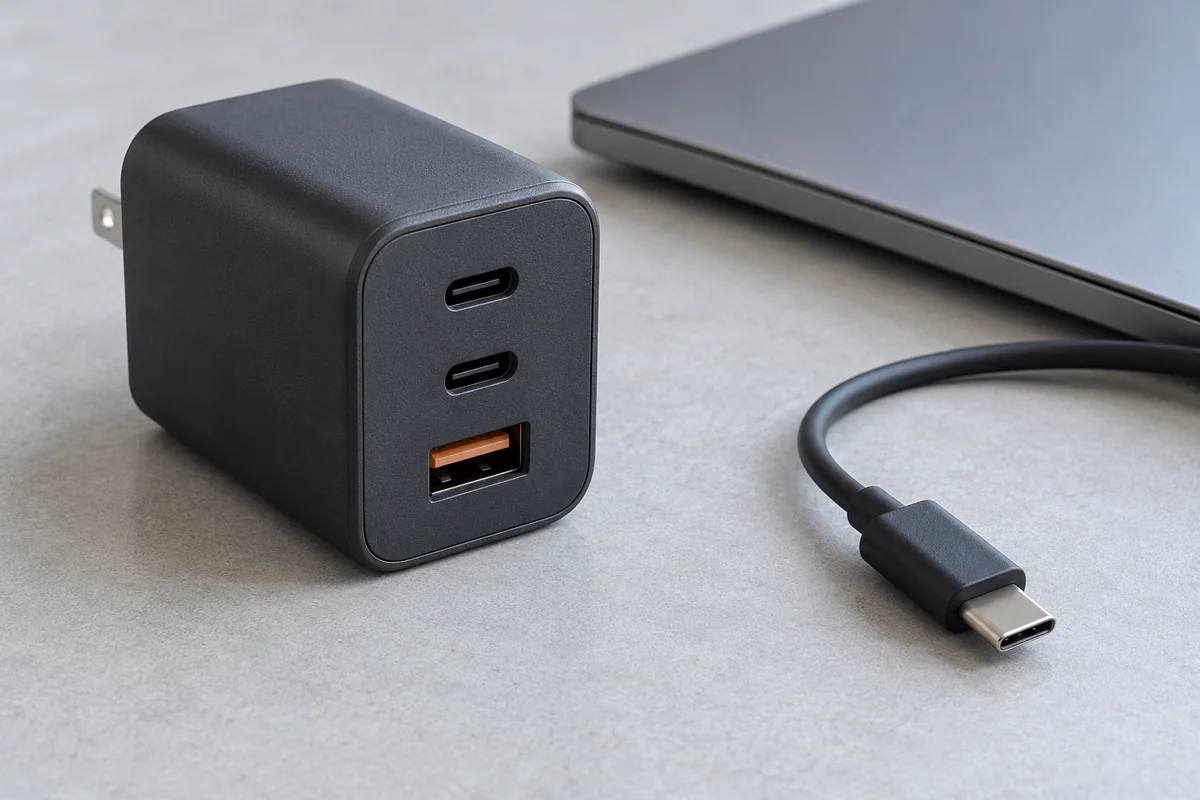
A multiport charger can publish a high single-port figure and lower allocations when several ports are occupied. The relevant row is the simultaneous combination you intend to use. Adding the largest number from each port's separate specification can create a total the product never claims.
Use the exact model number. This example concerns Anker 735 Charger Nano II 65W, model A2667. Similar names and other Anker model numbers are not interchangeable evidence.
Read the chosen combination row
| A2667 simultaneous ports | Published allocation in the cited manual | Arithmetic total |
|---|---|---|
| C1 + C2 | 45 W + 20 W | 65 W |
| C1 + A | 40 W + 22.5 W | 62.5 W |
| C2 + A | 12 W + 12 W | 24 W |
The arithmetic total helps you compare rows, but each per-port allocation is the useful field for a device. A 65 W sum does not mean either connected device receives 65 W. The table is a published distribution limit, not a measurement of what two devices actually draw.
Put requirements beside allocations
For an illustrative plan, Device L has an officially documented requirement you have recorded as 40 W for the intended use, and Device P has a documented supported mode of 18 W. Placing L on C1 and P on C2 gives published allocations of 45 W and 20 W in this table. You must still verify the output profiles, cable conditions and each device's supported input; the wattage comparison alone is not a final compatibility result.
Moving the same pair to C2 and A changes the cited row to 12 W plus 12 W. That no longer meets those illustrative requirements. The port names, not just the count of connected devices, change the decision.
Preserve conditions and unresolved behavior
Record the exact ports you plan to occupy and whether other devices will be added. Consult the manual for the relevant full combination. Do not assume the two-port allocations persist with a third connection or infer reconnection behavior that the documentation does not state.
If you cannot find a row for the planned combination, mark it unconfirmed and ask the manufacturer. Do not interpolate a convenient split from the charger total.
Keep the evidence with the plan
A concise record is enough: model A2667, manual URL, chosen port row, device requirements, cable identities and unresolved conditions. Manufacturer documentation is the basis here. This site has not tested the charger's output or claimed a measured charging time.
Sources and scope
Official documentation checked October 17, 2026. The exact models, versions and conditions below matter.
- Anker 735 Charger Nano II 65W A2667 official manual — A2667 simultaneous allocations: C1+C2 45 W+20 W; C1+A 40 W+22.5 W; C2+A 12 W+12 W. Model-specific published allocation, not a device power measurement.