A card's advertised read speed is not the same field as the minimum sequential write class required for recording. Begin with the device's exact recording mode, then find the manufacturer's stated card requirement. “4K” by itself is not enough to select a card.
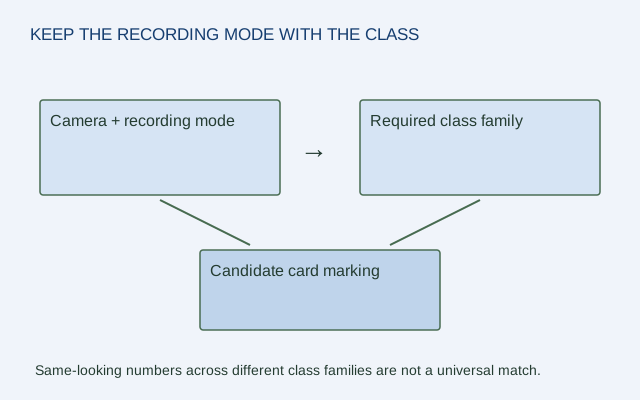
The SD Association defines several speed-class families. Preserve the family symbol as well as the number. Equal-looking numbers across families do not establish that the markings are universally interchangeable for every device requirement.
Keep the requirement and marking in matching fields
| Record | What to enter |
|---|---|
| Device model | Exact camera or recorder |
| Recording setting | Codec, resolution, frame/bit rate and relevant options |
| Manufacturer card requirement | Capacity family and required speed-class family |
| Candidate card | Exact model, capacity family and printed class |
| Status | Confirmed match, explicit mismatch, or unconfirmed |
A maximum read-speed figure is not a replacement for the required write-class field. Nor should a general speed-class explanation override a device's more specific supported-card conditions.
Read the recording-mode table
Sony's ILCE-6700 help guide lists different requirements by recording setting. In the cited movie conditions with proxy recording off, XAVC HS/S 4K up to 280 Mbps requires SDXC V60 or higher, while XAVC S-I 4K at 600 Mbps requires V90 or higher. Those exact model and setting conditions belong beside the requirement.
It would be wrong to shorten that to “all 4K recording needs V60” or “any 4K camera works with V30.” Another mode, option or camera can have a different requirement. When proxy or simultaneous recording settings change, return to the relevant table rather than retaining the old row.
Match definitions to the actual recording row
The definitions below concern minimum sequential writing under the relevant SD standard test conditions. They are not measured results for an individual card.
| Class family and mark | Definition in its family | Sony ILCE-6700 mode correspondence, proxy off |
|---|---|---|
| UHS Speed Class U3 | Minimum sequential writing 30 MB/s under its class conditions | U3 alone is not the V60/V90 requirement stated for the two modes below |
| Video Speed Class V60 | Minimum sequential writing 60 MB/s under Video Speed Class conditions | XAVC HS/S 4K up to 280 Mbps: SDXC V60 or higher |
| Video Speed Class V90 | Minimum sequential writing 90 MB/s under Video Speed Class conditions | XAVC S-I 4K 600 Mbps: SDXC V90 or higher |
Keep the required family and any same-family higher-class allowance exactly as the device guide states. Do not substitute a different family merely because a number looks similar, and do not derive a replacement card requirement by dividing the movie bit rate by eight.
Use a three-outcome decision
A candidate explicitly meeting the required family, class and other documented conditions can be recorded as a specification match. A card below an explicit requirement is a mismatch for that plan. If the relevant marking, exact model or required mode is unknown, leave the decision unconfirmed.
Do not invent a measured result from the card label. This guide has not recorded footage or tested a card's sustained performance. If the manufacturer supplies a supported-card list or additional recording conditions, keep those with your worksheet.
Save the mode with the card record
Write the planned mode on the selection note. That prevents a later switch to a more demanding recording setting from silently invalidating the original choice. The useful output is a precise model-and-mode match, not a broad recommendation based on the largest number printed on the package.
ORIGINAL REFERENCE DIAGRAM
Sources and scope
Official documentation checked October 17, 2026. The exact models, versions and conditions below matter.
- SD Association: speed class — Speed-class families describe minimum sequential write performance under their conditions; equal numbers across families do not establish universal interchangeability.
- Sony ILCE-6700: memory cards that can be used — For listed movie settings with proxy recording off: XAVC HS/S 4K up to 280 Mbps requires SDXC V60 or higher; XAVC S-I 4K 600 Mbps requires V90 or higher.
- SD Association brochure: Speed Classes table — The minimum sequential write table lists U3 at 30 MB/s, V60 at 60 MB/s and V90 at 90 MB/s under the relevant class conditions.